Pages

Monday, May 2, 2011

South Riding


Masterpiece is back y'all! After what I thought was a rather disappointing showing with Upstairs, Downstairs, viewers have a new three-part series to sink their teeth into. South Riding is like Anne of Green Gables meets Jane Eyre meets the gritty realism of post-WWI and pre-WWII England. Gone is the shiny veneer of the Victorian era; WWI, the war that was supposed to end all wars, took millions of lives, and this loss left all of Europe jaded. The effects of this war's awakening can be seen 15 years later in South Riding, a coastal town in Yorkshire. Being one of a surplus of two million unmarried women (their would-be spouses lost in the war), the protagonist of the series, Sarah Burton, is full of outlandish ideals such a pacifism and women's rights. She comes back to her hometown to be headmistress of a girls' school after teaching all over the world because she wants to make a difference. Her "radical" thinking doesn't immediately win her any fans, but her students adore her, and she slowly wins people over.

The cast is a who's-who of Masterpiece favorites. Anna Maxwell Martin, who was a delight in Bleak House, plays Miss Burton with such aplomb it's hard to imagine another actress taking on the role. Mrs. Beddows, a champion for Miss Burton, is played by Penelope Wilton, who most recently starred in Downton Abbey. Robert Carne, our Edward Rochester, is played by Sense and Sensibility's David Morrissey, who can break your heart with one glance. Everyone has their struggles in South Riding, but I think Mr. Carne might beat them all. He has an estate that is going bankrupt; his prized horse that he was going to sell to make everything better breaks its leg on barbed wire (hello sybolism and WWI allusion), and he has to put it down; his daughter Midge is so shell-shocked and damaged (from what we don't know) that she constantly worries that her father will leave her and never come back; and, finally, Mr. Carne's wife Muriel is insane and residing in an insitution, another obvious reason for the strain on the estate. These awful circumstances leave me full of dread for an unhappy ending. Miss Burton and Mr. Carne have an obvious yet tragic attraction, and this doesn't seem like a story where everyone lives happily ever after. Still, the acting is superb, and the plot is so realistic that I can't help but lose myself in it.

Because I think that there is always room for improvement, I do have one quibble with South Riding. There are three episodes of the series, but they're only 50 minutes each! Just when I felt like I could smell the sea air and feel the craggy cliffs beneath my feet, when I was so abosorbed I felt like I was in South Riding, Laura Linney's voice-over interrupted to tell me that the next episode would be here in a week. I'd rather stay up until 11 p.m. and watch the whole series than have to wait a week to see what happens. It spoils the mood, and the magic that each episode creates doesn't build. It's like getting to a cliffhanger in a book and then having to give it back to the library. It's a small problem, but vexing nonetheless. However, I already love this series, and I will tune in each week. The characters' problems are more complex and more dire than simply who marries who or who's in charge of making the night's menu. In the debate over what is more interesting, life upstairs or downstairs, I'm definitely more of a downstairs girl. And South Riding exemplifies the heart and passion that is seen in people who've struggled. I will definitely be watching next week, even if I don't feel an ocean breeze immediately.


image via

Tuesday, April 26, 2011

Glee: Don't be a drag, just be a queen


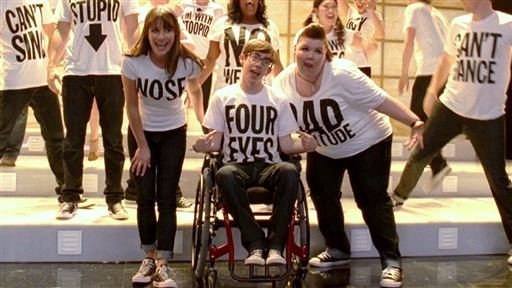
Oh, Glee. Tonight's episode left audiences wanting. Wanting for more substance, more charm, more charisma. It seems that plot and character development have fallen by the wayside in lieu of soap boxes and A-list guest stars. And, while I am all too happy for the series' success, I think that some changes need to be made.

First, while I understand that Oscar winners and Broadway divas are fantastic and should be showcased, the entire plot doesn't need to stop to accommodate them. Gwenyth Paltrow's character, while fun, zapped all of the energy from her episodes. And theme shows (I'm looking at you, Britney and Bieber), are a great way to attract advertisers, but not necessarily helpful to the story. If it doesn't create a dynamic arena for plot, then it needs to be cut.

Also, I didn't realize that I was watching an after-school special on Tuesday nights. It seems that each episode is devoted to a multitude of issues, be it bullying, identity and/or self-acceptance (and that was just tonight's show). I do think that Glee, as a powerful, popular show, has a right and a duty to take a stand on issues. We live in a world where people commit suicide for being harassed, yet as a nation we mocked a 13-year-old's music video. What does that say about our society? And I think that shows like Glee, with its enormous following, can be a force for good in creating a more loving, accepting world. However, I think that these messages would be more powerful and reach more people if each one was given it's due. Lumping a handful of problems together creates a confusing message. Stark strength of purpose is what's needed to get people to listen, not a smorgasbord of today's dilemmas. Power isn't in quantity; it's quality that creates an impact.

I'm hopeful for these next episodes. Perhaps it's a sophomore slump, or maybe Glee's just out of key. I'll hum a few bars, and maybe we'll harmonize once again.

image via

Wednesday, April 20, 2011

New Favorite: AMC'S "The Killing"


Since I have been underwhelmed with by Masterpiece's Upstairs, Downstairs, I found myself looking for something I could really sink my teeth into on Sunday night. Thanks to Fancast, I've recently been hooked on AMC's The Killing. Dark, cold and utterly mesmerizing, it's a cerebral program that isn't as focused on the victim as it is the psychology and motivation of the crime itself. While some might find this detachment chilling, I think that it's a unique way of looking at the rather tired genre of the crime TV show. Based on a Danish show, The Killing is right in the midst of the world's fascination with Swedish/Scandinavian crime novels and TV. Thanks to the success of Stieg Larsson's Girl With a Dragon Tattoo and Wallander, starring Kenneth Branagh, crime from the frozen regions of Europe has never been so hot. And The Killing, while set in American, brings that iciness to our backyard.


Set in Seattle, The Killing focuses on the brutal murder of Rosie Larsen, whose secrets are slowly revealed in each episode. Starring Mireille Enos (who was brilliant in Big Love) as lead investigator Sarah Linden and Swedish actor Joel Kinnaman as Stephen Holder, her partner, the plot becomes more and more twisted and tangled with each new clue. Linden, who is supposed to leave her post and move to warm climes in California, keeps trying to ditch the investigation, but her boss asks her to stay again and again. Thus far, the audience can can see that the search for Rosie's killer is taking its toll on Linden's personal life, and her fiance alludes to the fact that she has a tendency to become obsessed with her cases. Holder shows that he resents Linden's staying, and we can see that he has a tendency to go rogue, as evidenced by his bribing Rosie's classmates with drugs (albeit fake ones) to get more information.

The story also takes us to Rosie's home, where we see how her death is causing her family to slowly crumble, weak from grief. Her mother, Mitch, spends hours in Rosie's room or roaming the halls of her high school, and her father, Stanley, tries to keep them all emotionally and financially above water. And, we get to know mayoral candidate Darren Richmond, whose campaign car is where Rosie's body was left. His wheeling and dealing is suspect, but, for now, there appears to be no connection between the two.


As we delve deeper in everyone's psyche, hopefully Rosie's murderer will be revealed. Yet, we're only four episodes in, and I can't tell what's going to happen. And that's the way I like it.


images via here and here

Monday, April 11, 2011

Review: "Upstairs Downstairs"


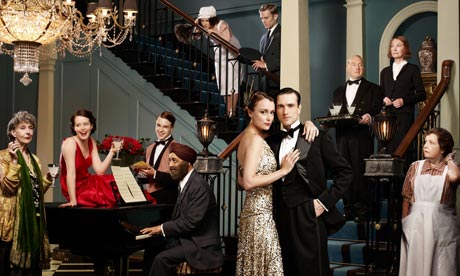
Last night, PBS debuted its newest miniseries, Upstairs Downstairs, a continuation of the beloved series that went off the air in the late 1970s. It takes place in 1936, right when Hitler is gaining power but Wallis Simpson is the Brits' biggest enemy. Since viewers only got to see one hour-long episode of the three part series, I can't truly decide how I feel about it. It was entertaining, and I loved the set decor and costumes, but I don't love any of the characters yet. This is not for lack of fantastic actors. With stars from Anne Frank, Little Dorritt, Cranford, and the original Upstairs Downstairs, there is enough twinkling talent to rival the glittering chandeliers at 165 Eaton Place. However, not even great performers can give life to a trite script. For example, Claire Foy, who was magical as Amy Dorritt in Little Dorritt was annoying as the petulant Lady Persie, and Ellie Kendrick's Anne Frank from last spring's Diary of Anne Frank, a powerful performance, seemed a distant memory as Kendrick wailed and bemoaned her lot as the blubbering maid Ivy.

While I did enjoy the episode, I did think the plot was a bit cumbersome. There seemed to be a checklist that the screenwriters had for this first part. Meddling mother-in-law? Check. Free-spirited maid? Check. Sweet footman from the wrong side of the tacks? Check and check. I could go on and on, but every time a new character was introduced, I couldn't help but think "Oh, that's like so-and-so from such-and-such." And moments in the plot felt rather far-fetched. Rose, our connection to the old series who spent forty years as a servant, gives up being the head of a staff employment agency to be a housekeeper? Why?

Last night I found myself longing for Downton Abbey, the tender portrayals of both the aristocrats and the servants. Even the most odious characters could be sympathetic at times (with the exception of that sociopath Thomas the footman. He was just creepy). The love story of the maid Anna and the valet Mr. Bates alone is worth watching all four 90 minute episodes in one sitting, and even the most melodramatic moments (The Titanic, WWI, miscarriages caused by bars of soap on bathroom floors) were full of heart.

However, Downton has a luxury that Upstairs Downstairs does not: time. This series will only be three hour-long episodes, and that itsn't a lot of time to introduce a dozen new characters and encompass life in England before WWII. Once the war began, bombs fell on London, and it didn't matter whether one's life took place upstairs or downstairs; survival was what counted. So, trying to capture that small window of life right at the cusp of change is a difficult task, and I don't evny the filmmakers that. Yet, I think that the story would be better if it weren't bogged down in so many politcal and social details. Instead, all focus should be directed towards the people in this story, and how they come together as an unequal but committed unit. Then perhaps this new chapter at 165 Eaton Place might feel less like a familiar tale a more like a fresh take on an unconventional family.


image via

Saturday, April 2, 2011

Review: Jane Eyre


I'm going to level with you: I love costume dramas. Now, I don't love them as a favorite genre; I consider them a way of life, an art form to study. Give me Austen, Dickens, any Bronte and a day to bask in the glory of the film, and I am the happiest girl in the world. I own versions from several different decades of all of my favorites, including both the 1943 and 2006 adaptations of Jane Eyre. I'm not going to brag or anything (since I haven't expressed my geekiness fully), but I consider myself an expert on heritage films. I took several classes in college on film adaptations, and it only fueled my passion.

You can imagine how incredibly geeked up I was to find out about this newest version of Charlotte Bronte's oeuvre. It didn't seem like it was ever going to come to my city, but a little internet sleuthing and a 30 minute drive is a small price to pay for such a glorious movie.

Yes, I used the word glorious. Because I LOVED this version. Had I not been on the other side of town with errands to run, I would have bought another ticket and stayed to absorb the beauty of this gem all over again. The scenery? The costumes? The acting? The dame herself, Judi? I can go on and on, ad nauseum. I was worried about a 2 hour version of JE since my favorite version that tells the whole story is a whopping 4 hours. Can a feature film contain a story that is normally produced in miniseries format? This one absolutely does.

Is the story condensed? Yes, of course. Are some complicated details smoothed over? Understandably. One notable exclusion is the face that St. John Rivers, Jane's pseudo rebound post broody Rochester, is Jane's cousin. Yes, first cousin. And, I understand why the filmmakers decided to omit that part; it's shocking to modern audiences and another complication in the last 15 minutes of the film. To be honest, I didn't really miss it.


Look at the chemistry in the picture above. Can you stand it? Michael Fassbender's tender interpretation of a normally steely Edward Rochester was refreshing and immensely satisfying. Mia Wasikowska was stoic as strong-willed Jane, a wonderfully feminist character in a decidedly unfeminist time. Mrs. Fairfax's role was amped up to give Judi Dench some room to showcase her considerable acting chops, and it was perfect. She was warm and maternal, yet she conveyed an array of emotions with just the shift of her eyebrow. An utterly fantastic performance that rounded out a strong cast.

At times a bit spooky (director Cary Fukunaga drew from the novel's gothic elements) and and many times romantic, this newest adaptation of Jane Eyre joins 27 other films, and, unlike some of the more forgettable versions, it will stand the test of time.

images via

Tuesday, March 22, 2011

An Open Letter To The Kings of Leon


Dear Caleb, Nathan, Jared and Matthew,

How are you? I feel like we've been out of touch for a while. Maybe it's because you're so busy selling out stadiums all over the world, or maybe it's because I haven't been listening. Either way, we haven't heard from each other. Can I be honest? I miss you guys. But not the you of today. Remember when you looked like this:


No fancy haircuts, no stylists, just a family band recording in their garage whose mom (or aunt in Matthew's case) would tailor their pants for them because they weren't tight enough. Remember those guys? Caleb, I couldn't understand what you were singing, but I knew that you meant every word. Now, instead of songs about beating people up ("Four Kicks" from the wonderful Aha Shake Heartbreak), you're writing about needing people ("Use Somebody," pandering set to music if ever I've heard it). Where's my beloved bad ass band?

I've been to two of your shows, 2005 and 2007 at the Ryman. You were rowdy, reckless and rocking. People got into fights in front of me, everyone was dancing, and the crowd loved you. Now, I understand that it's hard to write raw, emotion-filled songs when your life is so perfect. You're seeing beautiful women, making boatloads of money and getting tons of radio play. And that's wonderful. I've always wanted for you to succeed. However, I wish you could stay a bit truer to your roots. This last album was too slick, too arena-friendly. It sounded like a producer worked it over, and that's not who you are. Everyone is comparing you to U2...is that what you want?

So, here's my advice. Tell your people to go on vacation. Sit in the studio and make music, not for the radio or the concerts but for your fans. Remember us? The fans who've known and loved you for eight years? We loved you when your hair was a mess and your jeans were a bit too tapered. Can we be friends again?

I'll always consider myself a fan, boys. I'm not fair weather, and, I get it, you've got to go mainstream. But, please, don't wait to return to your roots. They're waiting for you on "True Love Way."

Come home soon, Kings.


1. via 2. via

Thursday, March 3, 2011

Gone Before Their Time: TV Shows Canceled Too Soon


We're nearing the time when we find out what shows will stay on and which will be kicked off the air. What with all of the Charlie Sheen wizarding/tiger blood/winning -- duh drama and looming permanent demise of Two and a Half Men (a show I have never, ever liked), I couldn't help but think about shows I've truly loved and lost.

Of course, Gilmore Girls is the first I think of. An innocent bystander of contracting disagreements between the studio and creator/writer/producer/genius Amy Sherman Palladino, the seventh season of the show, without Palladino at the helm, felt just wrong. Lorelai married Christopher? Rory didn't get a job with The New York Times? Things didn't get back on track until the last two or three episodes, but the damage was irreparably done to a wonderful story. I have friends who won't recognize the final season as legitimate, and, try as I might, I can't be satisfied with its ending. I'd love to know how Palladino would have wrapped things up, but, alas, I guess we'll never know. Perhaps Luke and Lorelai are married with a baby or two and Rory is working at some fabulous paper or magazine in New York, but, unless there's a movie, I'll never be sure.


Another victim of TV politics, Pushing Daisies, the story of magical piemaker Ned and his charming girlfriend Chuck , was cruelly canceled in its second season after the writer's strike in 2007-8. It came back once things were resolved, but the fledgling show couldn't regain any momentum. It was a lovely quirky story: boy meets girl, girl dies, boy brings her back to life with one touch but can never touch her again, boy and girl solve crimes. If Tim Burton wanted to do CSI: Romeo and Juliet with Julia Child as an executive producer, their show would have been Pushing Daisies. There was some closure to the final episode, but I would prefer to still be basking in the warm, sweet world of Ned and Chuck instead of having stale slices of seasons on Netflix. Oh well.


A more recent show to meet the ax is The Good Guys on FOX. It was a throwback to 1970s buddy cop movies, and I loved each goofy episode. Unfortunately, viewers did not. It was a Friday night show, the kiss of death for most programs, and, as most freshman series are wont to do, it was at times inconsistent. But the acting was great, and who doesn't love a mustachioed renegade cop and his straight-laced partner? I'll miss you, Good Guys, even if I hardly knew ye.

The Grim Reaper of TV is at times unpredictable, ignoring a show's popularity or age. A series can last for 10 seasons or 10 episodes and still come to an end. Here's hoping my favorites have a long and healthy run. And as for Two and a Half Men? I'd rather stay tuned for Jon Cryer's next project...Pretty in Pink 2 please?